

Bad Game Design

I’m trying to be a bit more straightforward in my posts. People seem more receptive when I don’t write a Tale of Two Cities.
Trying.
Anyways I want to talk about bad game design. It’s a term I have heard thrown around a lot both in the tabletop community and among people who play video games. It is very popular with armchair critics who have not actually put any time into designing a game because it’s a really easy, half-assed way to dismiss design elements that they do not understand.
Recently I ran across an EIGHT HOUR video of a guy breaking down Sonic CD. I laughed aloud at the run time. I spit out some tea.
“Who in the Hell is going to watch an eight hour video about Sonic CD?”
Sonic CD has some notoriety among Sonic fans because compared to many other games in the series, namely the earlier Genesis outings, it is a bit hostile towards forward momentum. It seems to do everything it possibly can to screw the player over when they are trying to rush through levels.
Because of this the “bad game design” moniker is thrown around quite a bit. It’s a Sonic game, you gotta go fast! Sonic 2 was notable for maintaining a roller-coaster pace through the majority of its runtime, and playing them back to back is a night and day experience.
I popped the video on. And then realize I had been watching for an hour. And then two hours. And…
Well, I’m a loser. This is what happens when you are out of work. Sorry mom and dad.
The brilliant thing about the video was how it went in-depth in the design process and philosophy. I don’t think people really get just how much thought is put into games beyond what you actually see up on the screen. We are inundated with content out there, a wealth of it. We have a paralysis of choice so the best bet to “keep up” is to quickly zoom through these experiences and onto the next one. Most people are not autistic enough to drill down into Bubsy 3D like Ulillillia and discover the highest possible Z co-ordinate in the game because he played it for thousands of hours. Games are like books, or movies - you finish it, you discard it, or in the case of the compulsion loop gambling emulators a lot of persistent online gaming “platforms” are these days, you simply play until you are sufficiently bored. But there is often very little analysis going on because time is finite, most people are NOT designers, and therefore they really don’t care about intent.
Sonic CD was intended to be a more vertical experience that put a high demand on players skill in navigation and precision of control over the character. The hated “peel-out”, where Sonic stands in place and charges up to running speed is often laughed at because the outcome of it is very often Sonic running headfirst into a set of spikes or an enemy since it does not offer him any defense. But when utilized in the context it was intended, it’s essential to reaching places Sonic would otherwise have a hard time getting too due to the slower speed of springs or the more well-loved spin-dash, which also offers Sonic offensive and defensive abilities.
The game emphasizes time trials and replayability because it wants players to really get to know the levels and become familiar with their layout. This is further promoted in signposts that allow Sonic to travel back in time and locate and destroy robot generators that will result in a “good future” for the levels he is exploring, and ultimately, a good ending - which amounts in a five second throaway cutscene, and is hardly a reward.

Unfortunately, part of the reason most people don’t play this way is because the designers threw the players a bone by allowing Sonic to achieve the same ending by collecting Time Stones during bonus stages. If Sonic collects them all, the robot generators are automatically destroyed in every level after Sonic has collected them, and there is no need to engage with the levels.
It was a self-defeating flaw that undermined the philosophy of the design behind the game, and has led many people to dislike Sonic because the levels simply aren’t as fun to run to the end of when you are avoiding engaging with the time travel system.
But boy, when you DO, is it ever fun.
You naturally become more skilled upon subsequent runs. You learn techniques you would never otherwise need to use, and this creates a flow in the game state that feels really natural and fun to master. The game is designed very well and in line with the vision of the creator, but the aforementioned concessions to accomodate players who were familiar with the pace of Sonic 1 underminds the design. Bad game design is not the problem - an inability to fully commit to the intended design is.
The same is true of a more recent game called Penny’s Big Breakaway, not ironically made by the same people who created Sonic Mania a few years back. Penny had a relatively lukewarm reception among many critics who found it frustrating. Penny relies entirely on her yoyo to gain any kind of momentum. The levels are set up in a fairly linear fashion, and walking around and picking up collectibles is an unsatisfying and even frustrating experience if you are not actively attempting to master Penny’s acrobatic control scheme. It also encourages controlling the yoyo with the right stick on the controller, which is initially uncomfortable and frustrating. And because it offers a simpler control scheme which lets the player control the yoyo more easily with the square button while sacrificing the ability to control its direction, impatient players will often revert to that and come away feeling unsatisfied.
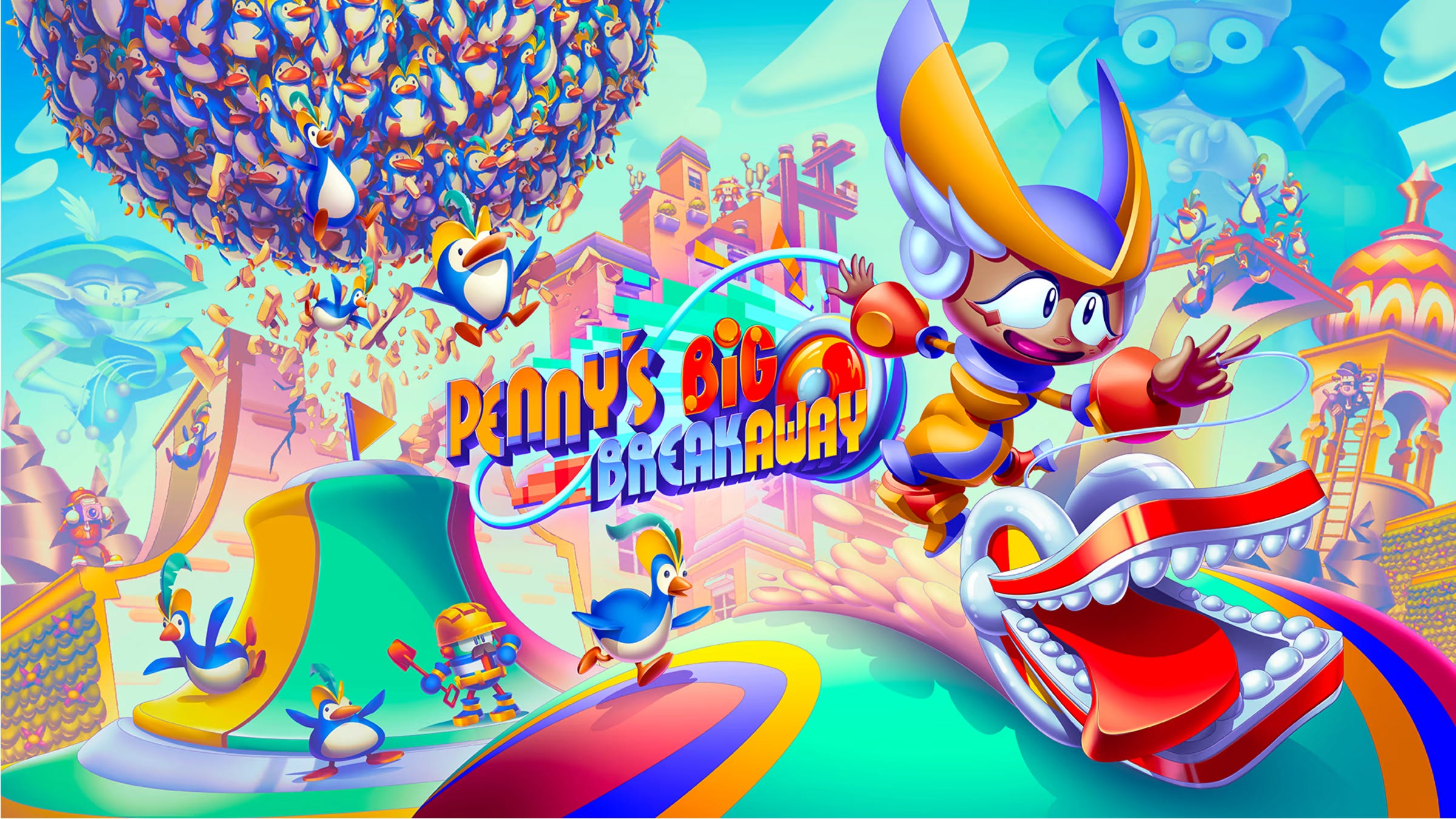
Players who do persist with the more demanding control scheme will find that controlling Penny is enhanced greatly by the ability to swing on a whim in any direction. But this freedom of control is earned through trial, error, and perisistence. So far I have put over ten hours into Penny and am still mastering the controls. But compared to the first few hours of play, I am blowing away previous times I set in earlier levels, and there is a flow present that is immensely satisfying - more dangerous, to be sure - Penny’s world is full of pits and hazards that can easily kill a run, and navigating them safely is far easier when you are moving at a slower and more deliberate pace, but this caution results in a game that feels more like a mediocre Mario platformer than a precision, reflex based game of speeding against the clock.
Again, a lot of critics did not seem to realize this and slapped the “bad design” label on Penny. So you will often see a split in opinions - Penny is either the best 3D platformer ever made, or it is mediocre, heartless dreck.
The last statement is the most painful to bear witness to because it completely discards the love and effort Evening Star put into making it. They build an engine for Penny from the ground up with an experimental programming language called Beef. There is an excelleny Digital Foundry video that explores this, but largely focuses more on the technical effort behind it, and doesn’t discuss much of the philosophy of design.
While designing Procyon Frequency, a game which is an homage to the Star Control series of old, we have made a lot of deliberate deviations from the groundwork laid out for us, and none of these decisions have been arbitrary. For example, resource collecting was one of the most criticised points of Star Control 2 and it’s other successors, Mass Effect 1 and Star Control: Origins, so we have been very cautious to avoid a similar pitfall. We have ship designs that keep in mind the alien culture of the races they belong too, and to a deeper degree, the actual plot of the story and how that technology will mesh within that plot. Musical choices are not spared this thought - genres and styles were chosen based on the flavor of the aliens. The Cosmodromium theme is the best example, as they are a machine race most comparable to Terminators. So a marching motif was chosen, with a musical cue taken from the Terminator theme embedded in the melody. There is a frightening alien creature that will show up if players fly too far out of a system and chase them until it eats them because of a potential memory overload if we were to let players fly out into space forever, and also to encourage that in PVP, players do not endlessly try to play run-and-chase. It fits in with the lore and is a key part in the story as well.
Most design decisions that are well planned will solve more than one problem. Gary Gygax was very aware of this when he wrote AD&D, and you can see that intermesh when you read the rules carefully. Things that initially might seem arbitrary are important moderators for other potential pitfalls. The simplest example in all of D&D, particularly earlier iterations, is how your stats both inform the player of what potential bonuses or negatives they will have as they pertain to strength, dexterity, or whatever, but how the primary result that determines this is also used to determine skill checks. A high strength may grant you a bonus to hit enemies and damage them, whereas performing a feat of strength during exploration that doesn’t have a specific rule tied to it can be quickly resolved by rolling a 20 sided die and rolling under that stat. It’s perhaps too simplistic for some, but it’s a concession for not having a list of proficiencies or skills that are ultra-specific to particular challenges.
Someone looking at the game on a surface level might call this “bad design” because utilizing this system means that all feats of strength are essentially equal in difficulty, and do not offer granularity. But for most campaigns, these instances do not come up often or can be adjudicated without a dice roll by the DM by simply using common sense and some basic understanding of what a character would most reasonably excel in. And the same goes for vague mass combat suggestions and miniature scaling - Gary offered us something, but some would argue that these mechanics being more of a suggestion than a rule makes them to obscure to be of use. An interesting perspective from people who are generally very comfortable with implementing “rule zero” to be frustrated by a lack of strict codification. These decisions were made for the benefit of players who might have a wide range of scales in their miniatures collections, rather than later efforts by WOTC to compartmentalize and capitalize on this by offering more rules, but only rules dealing with one particular scale of figures - which they conveniently happen to produce and sell.
There are things that can be pointed out as objectively bad of course - design that constantly contradicts or is in friction with itself, or whose apparent direction is in flux. Going back to video games, Sonic 2 has one level that is almost universally disliked called Metropolis Zone, where the game breaks pace for three rather long stages, doing everything it can to put flow breaking hazards in Sonic’s way. This is jarring considering every other stage in the game avoids this paradigm, and nothing before that level really prepares you for how frustrating it can be. Large screws Sonic has to run on while avoiding projectiles with enemies whose attacks are nearly impossible to avoid (thanks, big clawed crab robot) or crushers that Sonic will be smashed to death by with no reasonable way to react to if he is running at full speed contradict the entire rest of the game. And a back to back boss fight at the end of the game where Sonic has no rings to defend himself with are a wake up call for any first time Sonic player, since both of these enemies have attacks that practically demand prior familiarity with their patterns to avoid.
Even still I’d hesitate to call this “bad design”. The term is just so broad and non-specific, but video games of that era were also notorious for difficulty spikes for the more cynical reason of pushing players to buy instead of rent them. The rental market was a killer for the home console market, a problem developers no longer need to deal with since the days of the video store are long behind us. I am sure they are all grateful, and the games they make are far less prone to this, in the same way that they became far less punishing when they are locked to arcades, where the real goal of designers was to extract as many quarters as possible from potential players. These levels are frustrating, but they are more a symptom of the market than they were accidentally “bad” in nature.

No one is saying that players need to sit there and study the biography of every game to understand the designers intentions - their philosophy should present itself naturally as players go through the experience. And sometimes, in the case of Sonic CD and Penny, they do not because the ideas are not committed too in a strict way. Dark Souls will feel bad to anyone first picking it up, but it is lauded as one of the best games ever made despite an absolutely punishing escalation of difficulty. Fans have come to understand over time that these things, such as incredibly powerful skeletons guarding a graveyard right next to the starting point, are intentional as a way to funnel players in a particular direction without barring them off completely from exploring sections of the game that are otherwise open to them thereby rewarding them with powerful early gear should they survive the endeavor, or by teaching them game mechanics through trial and error. On a surface glance, these elements feel unfair and even cruel, but time and patience reveals the genius behind these decisions.
So before you take up the flag of “bad design”, it behooves you to pay closer attention to what might really be going on behind the screen or between the lines in your newest rulebook. You might discover that what you once previously found to be an arbitrary or neglectful design decision was very intentionally put there for a reason, and I think its owed to the people who spend hundreds of man hours creating these games to give them the benefit of the doubt before burning down their office.
Omg 8 hours for a video on Sonic???? Wow!